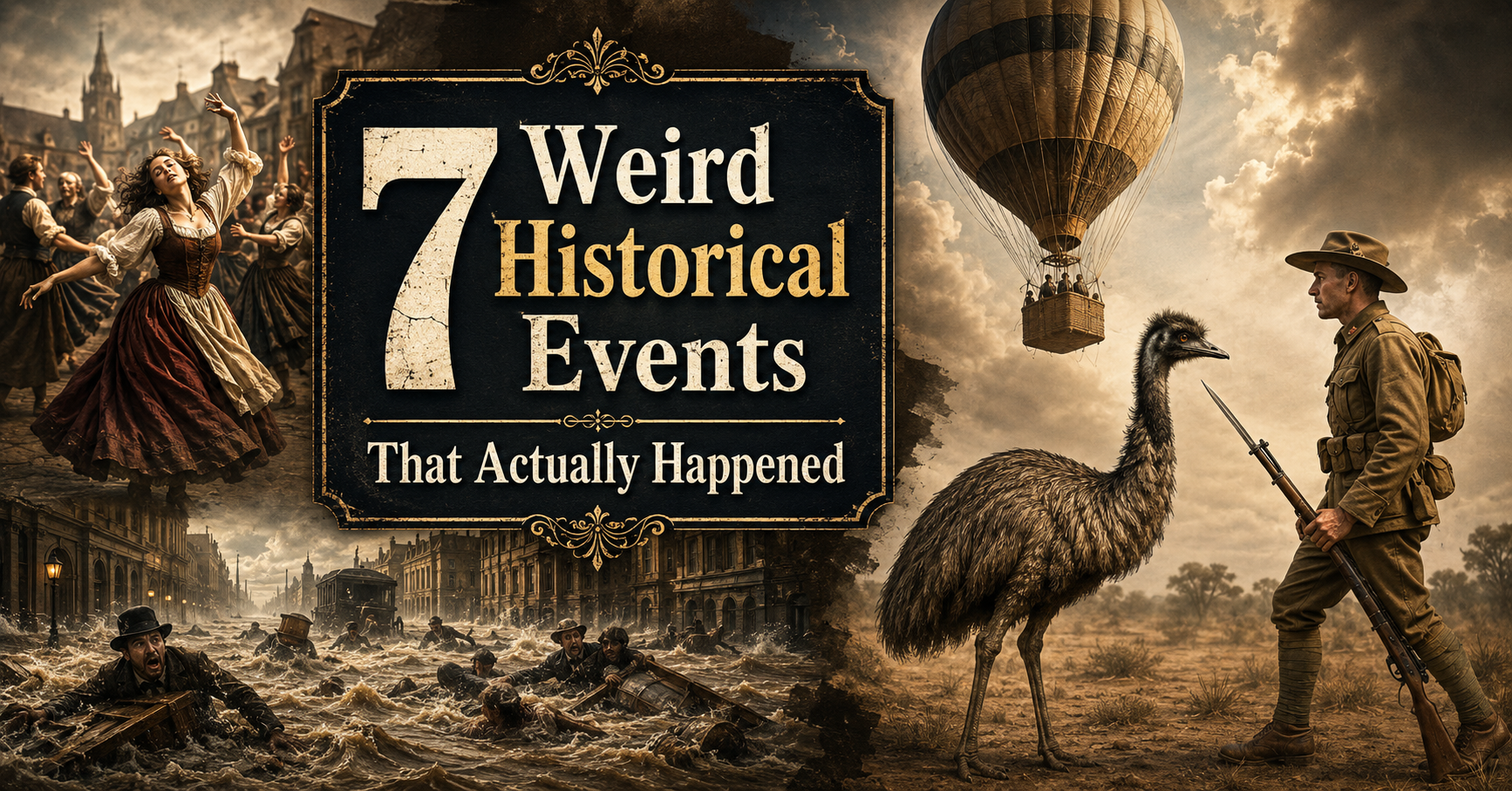
History is full of moments that sound like a joke someone made up later: a dead pope put on trial, a citywide outbreak of dancing, and a wave of molasses that crushed buildings. These weird historical events are documented, but the most dramatic retellings do not always get every detail right. Here are seven stories, with a closer look at what the records support.
1. A dead pope was put on trial (897)
In ninth-century Rome, church leadership was caught up in fierce political rivalries. In 897, Pope Stephen VI ordered the body of his predecessor, Pope Formosus, to be exhumed and brought before a church council. Formosus was dressed in papal robes and seated in court; a deacon was assigned to answer the charges on his behalf.
The council declared Formosus guilty and annulled his acts as pope. The episode, now called the Cadaver Synod, was more than grisly theatre: it was part of a political struggle over who had the right to rule Rome. The verdict was later overturned, and Stephen himself was imprisoned and killed. National Geographic’s historical account also cautions that some details of the corpse’s later journey—especially the story of a fisherman recovering it from the Tiber—may be legend.
Why it stands out: The trial shows how far political rivals could go to attack a predecessor’s legitimacy, even after his death.
2. Strasbourg experienced a dancing outbreak (1518)
In July 1518, dozens of people began dancing in the streets of Strasbourg, then part of the Holy Roman Empire. The outbreak continued for several weeks and was recorded by preachers and chroniclers. The city administration, clergy, and medical practitioners tried to respond, but the cause remains unsettled.
Popular versions often say that hundreds danced themselves to death. The surviving historical record is less tidy: the number affected and the death toll are debated, and explanations range from religious beliefs to stress and illness. The Strasbourg Museums’ 2018 publication is especially useful because it separates documented details from later interpretations.
Why it stands out: It is a reminder that a real historical event can be both well documented and still partly mysterious.
3. A London brewery sent beer into nearby streets (1814)
On 17 October 1814, a huge vat at Meux’s Horseshoe Brewery in London failed. A metal hoop broke, the vat split, and the resulting rush of beer damaged the brewery and nearby homes. The London Museum records that eight people died.
The event is often retold as a comic “beer flood,” but it was a serious industrial accident in a crowded neighbourhood. A collection record at the museum describes the broken vat and the damage to the surrounding street—an unusually vivid paper trail for an event that can sound like pub folklore.
Why it stands out: A familiar drink became a destructive flood because a large industrial vessel failed in the middle of a city.
4. London’s sewage problem became impossible to ignore (1858)
During the hot summer of 1858, raw sewage and other waste in the River Thames produced a stench so intense that it disrupted work at the Houses of Parliament. The London Museum explains that low water and hot weather left waste exposed along the riverbanks. Curtains were soaked in chloride of lime in an attempt to mask the smell.
The crisis became known as the Great Stink. Parliament moved quickly: a bill to fund a new sewer system passed in just 18 days, and engineer Joseph Bazalgette was tasked with building infrastructure that would transform London’s waste disposal. The episode is a strange turning point in public health: a smell helped force action on a problem that had been building for years.
Why it stands out: A city’s sanitation failure became so immediate and visible that it pushed lawmakers into action.
5. The Olympic marathon included a car ride and strychnine (1904)
The marathon at the 1904 St. Louis Olympics was run in severe heat over dusty roads, with only one official water station. Thirty-two athletes started; 14 finished. American runner Fred Lorz dropped out, rode in a car for part of the course, then ran back into the stadium and was briefly treated as the winner before the deception was discovered.
The actual winner, Thomas Hicks, had his support team administer strychnine mixed with egg whites, followed later by brandy. Strychnine was used as a stimulant at the time, though it is a potent poison. Smithsonian Magazine’s account notes that Hicks was barely able to stand at the finish. This was not modern sports science; it was a dangerous race shaped by poor planning and very different ideas about athlete care.
Why it stands out: One Olympic race combined heat, dust, a hitchhiking runner, and a winner given a toxic stimulant by his own handlers.
6. A molasses tank burst over Boston’s North End (1919)
At about 1 p.m. on 15 January 1919, a 50-foot storage tank ruptured in Boston. The City of Boston’s archives report that roughly 2.3 million gallons of molasses rushed through the North End, damaging buildings and knocking an elevated train off its tracks. The disaster killed 21 people and injured 150.
Residents had reportedly noticed leaks before the tank failed. Investigators later found that the tank was structurally unsafe, and a court-appointed auditor blamed its owners’ negligence. The fact that the liquid was molasses makes the event sound surreal, but the consequences were deadly and the investigation helped draw attention to stronger engineering oversight.
Why it stands out: It was a major urban disaster caused by a storage tank holding a product most people associate with kitchens, not mass destruction.
7. Australia sent troops to deal with emus (1932)
After World War I, returning soldiers settled as farmers in Western Australia. Drought, low wheat prices, and emus moving through fields made life harder; the birds ate crops and damaged fences. Farmers asked the government for machine guns to cull them, and a military-assisted cull began in 1932.
The episode became known as the “Great Emu War,” though it was not a formal war. The National Archives of Australia says the cull was quickly abandoned amid public opposition and the birds’ ability to scatter; fewer than 1,000 emus were killed. The nickname stuck because the operation paired military weapons with a wildlife problem that proved difficult to control.
Why it stands out: It is an unusually literal case of a government using military resources for pest control—and then deciding the plan was not working.
Why these weird historical events still matter
These stories are memorable because their details seem improbable, but each also reveals something ordinary: political power struggles, public health failures, unsafe infrastructure, or the limits of a government plan. The best way to enjoy strange history is to keep the surprising detail and check what the evidence actually says.
Sources and fact-check notes
Pages were checked on 2 October 2026. Dates below are the publication or update dates shown by the source; where a page does not show one, it is marked “undated.”
- Musées de la Ville de Strasbourg, “1518 La fièvre de la danse” (2018).
- Alberto Reche Ontillera, National Geographic, “In 897, the corpse of a pope was exhumed—to be put on trial” (20 August 2019).
- London Museum, “Tallis’s London street views: No. 53” (undated collection record; accessed 2 October 2026).
- London Museum, “The Great Stink of 1858” (undated; accessed 2 October 2026); UK Parliament, “Estimate of expense River Thames Purification Bill 1866” (archival document dated 1866).
- Karen Abbott, updated by Ellen Wexler, Smithsonian Magazine, “How the 1904 Marathon Became One of the Weirdest Olympic Events of All Time” (updated 27 June 2024; originally published 7 August 2012).
- City of Boston Archives and Records Management, “100 years ago today: Molasses crashes through Boston’s North End” (last updated 30 October 2025).
- National Archives of Australia, “Environmental issues from the not so distant past” (8 September 2022).