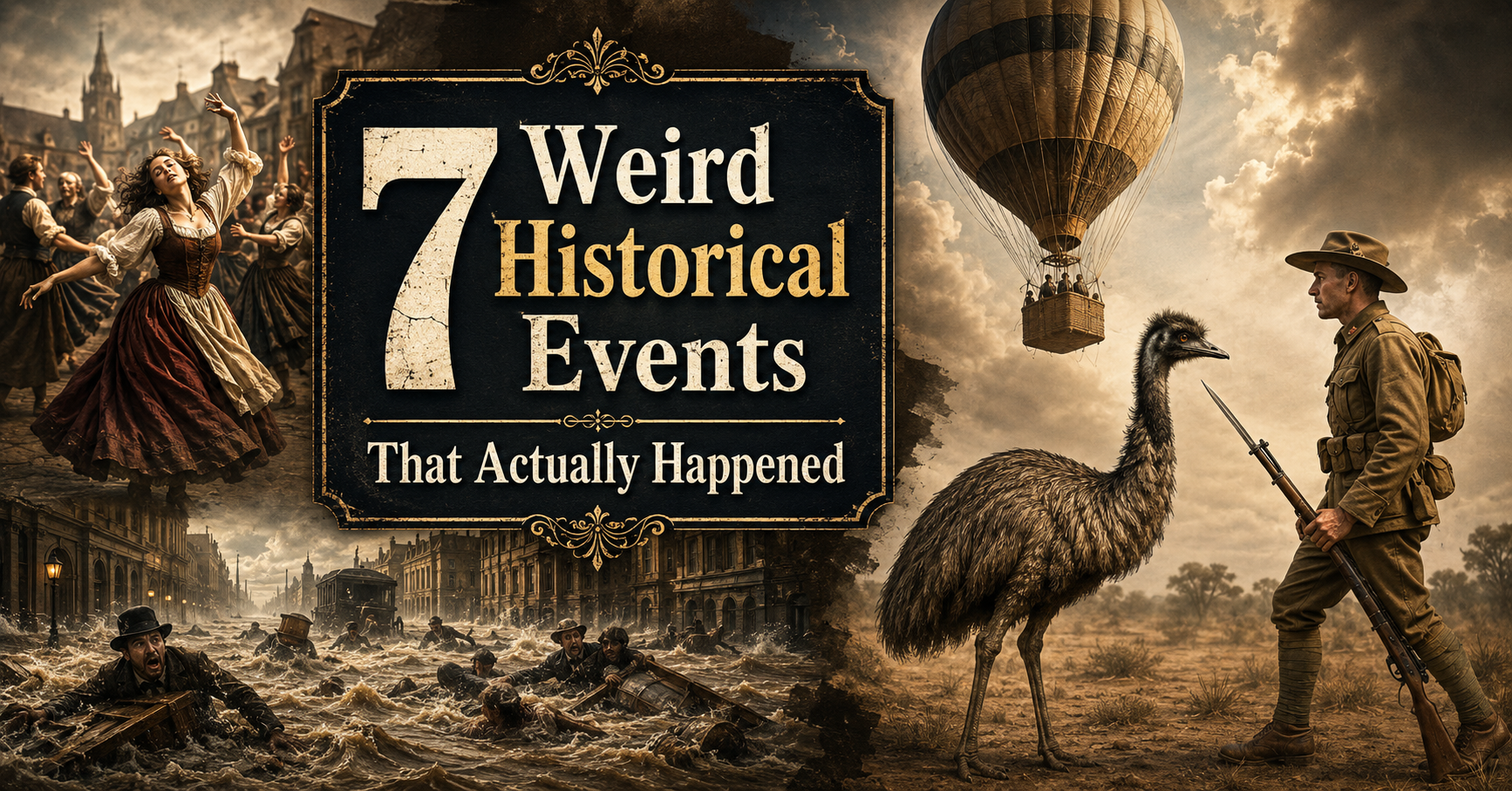
Some strange historical facts sound like embellished internet posts: a pope’s corpse called to answer in court, a day divided into ten hours, or a border crisis sparked by a pig. Yet each story below is grounded in historical records or reputable institutions. The fun is in the gap between the punchy version and what the evidence supports. You’ll find a fictional moon report, real disasters, and one “war” whose only casualty was a pig.
At a glance
| YearThe strange fact | |
| 897 | A dead pope stood trial |
| 1518 | Strasbourg recorded a dancing outbreak |
| 1793–1795 | France tried decimal time |
| 1814 | A brewery vat flooded London with beer |
| 1835 | A newspaper described bat-people on the Moon |
| 1858 | The Thames stench disrupted Parliament |
| 1859 | A pig triggered an international crisis |
| 1904 | Olympic runners faced dust, a car ride and strychnine |
| 1919 | A Boston molasses tank burst |
| 1932 | Australia attempted an emu cull |
1. A dead pope was put on trial (897)
Pope Stephen VI ordered the body of his predecessor, Pope Formosus, exhumed, dressed in papal robes and brought before a church council. A deacon answered the charges on the corpse’s behalf. The council declared Formosus’s papacy invalid, but later church leaders reversed the judgment. As National Geographic explains, this macabre trial was part of a political fight over authority in Rome.
2. Strasbourg recorded an outbreak of dancing (1518)
In July 1518, dozens of people danced in Strasbourg’s streets, and the episode continued for weeks. Local preachers and chroniclers recorded it, but historians still cannot give a certain explanation. The Musées de la Ville de Strasbourg cautions readers to separate the surviving evidence from later embellishments.
3. France tried a ten-hour day (1793–1795)
French revolutionaries briefly tried decimal time: ten hours in a day, 100 minutes in an hour and 100 seconds in a minute. The National Assembly describes the 1793 decree; the Foundation of Haute Horlogerie says decimal time was barely adopted and suspended in 1795. The decimal calendar lasted longer, so the two experiments are easy to confuse.
4. A brewery vat sent beer into London streets (1814)
On 17 October 1814, a huge vat at Meux’s Horseshoe Brewery failed, sending beer through the brewery and into nearby streets. The London Museum records that eight people died. “Beer flood” sounds comic now, but this was a deadly industrial accident in a crowded neighborhood.
5. A newspaper reported bat-winged people on the Moon (1835)
In August 1835, the New York Sun began a six-part series claiming astronomer John Herschel had found life on the Moon, including winged “man-bats.” Herschel made no such discovery: the reports were fiction. The Smithsonian notes that the tale spread to European newspapers. The strange fact is how a made-up report borrowed the authority of science.
6. The Thames stench disrupted Parliament (1858)
During the hot summer of 1858, sewage and other waste baked along the low banks of the Thames, producing the Great Stink. Parliament tried to block the smell with curtains soaked in chloride of lime. The London Museum says the crisis helped push a sewer bill through in just 18 days, leading to engineer Joseph Bazalgette’s major sanitation works.
7. A pig nearly helped start a war (1859)
San Juan Island was disputed by the United States and Britain when American settler Lyman Cutlar shot a Hudson’s Bay Company pig rooting in his garden. British officials threatened to arrest him; U.S. troops arrived, followed by British warships. The countries avoided battle and agreed to a joint military occupation that lasted 12 years. The National Park Service notes the pig was the only casualty.
8. The 1904 Olympic marathon mixed cheating with dangerous “medicine”
The St. Louis marathon began in high heat on dusty roads, with one official water station. Of 32 starters, only 14 finished. Fred Lorz rode in a car after dropping out, then ran back into the stadium and was briefly treated as the winner. The actual winner, Thomas Hicks, received strychnine mixed with egg whites and later brandy from his handlers, according to Smithsonian Magazine.
9. A molasses tank burst over Boston (1919)
On 15 January 1919, a 50-foot storage tank ruptured in Boston’s North End, releasing about 2.3 million gallons of molasses. The wave damaged buildings and knocked an elevated train off its tracks. The City of Boston records 21 deaths and 150 injuries. Its archives account says residents had noticed leaks before the failure.
10. Australia’s “Emu War” was a culling campaign (1932)
Returning soldier-settlers in Western Australia struggled with drought, low wheat prices and emus eating crops and damaging fences. Farmers asked the government for machine guns to cull the birds, and a cull began in 1932. The “Great Emu War” was a nickname, not a formal war. The National Archives of Australia says the effort was abandoned with fewer than 1,000 emus killed.
Myth vs. record: four details worth checking
| The dramatic versionWhat the evidence supports | |
| “Hundreds danced themselves to death” | Strasbourg’s museums document dozens dancing for weeks; the event’s scale and cause remain uncertain. |
| “The U.S. and Britain fought a war over a pig” | The pig’s death triggered a crisis, but negotiations prevented a battle; the pig was the only casualty. |
| “Astronomers found bat-people on the Moon” | The New York Sun published fiction; Herschel made no such discovery. |
| “Australia officially declared war on emus” | The National Archives describes a culling effort, later nicknamed the Emu War. |
Why these stories stay memorable
These strange historical facts reveal real pressures beneath their odd details: political rivalry, public-health failures, unsafe engineering and the limits of government plans. A good retelling keeps the surprise but checks the scale, cause and nickname. The record makes the stories more interesting, showing how people understood and responded to events in their own time.
Sources
- National Geographic — Formosus trial (20 August 2019).
- Musées de Strasbourg — Dancing outbreak (2018).
- French National Assembly — Republican calendar and decimal time (1793 decree record; accessed 6 October 2026).
- Foundation of Haute Horlogerie — Revolutionary decimal time (updated 30 January 2026).
- London Museum — Brewery flood collection record (undated; accessed 6 October 2026).
- Smithsonian Magazine — Great Moon Hoax (2 July 2015).
- London Museum — Great Stink (undated; accessed 6 October 2026).
- U.S. National Park Service — Pig War (accessed 6 October 2026).
- Smithsonian Magazine — 1904 Olympic marathon (updated 27 June 2024; first published 7 August 2012).
- City of Boston Archives — Molasses flood (updated 30 October 2025).
- National Archives of Australia — Emu cull (8 September 2022).