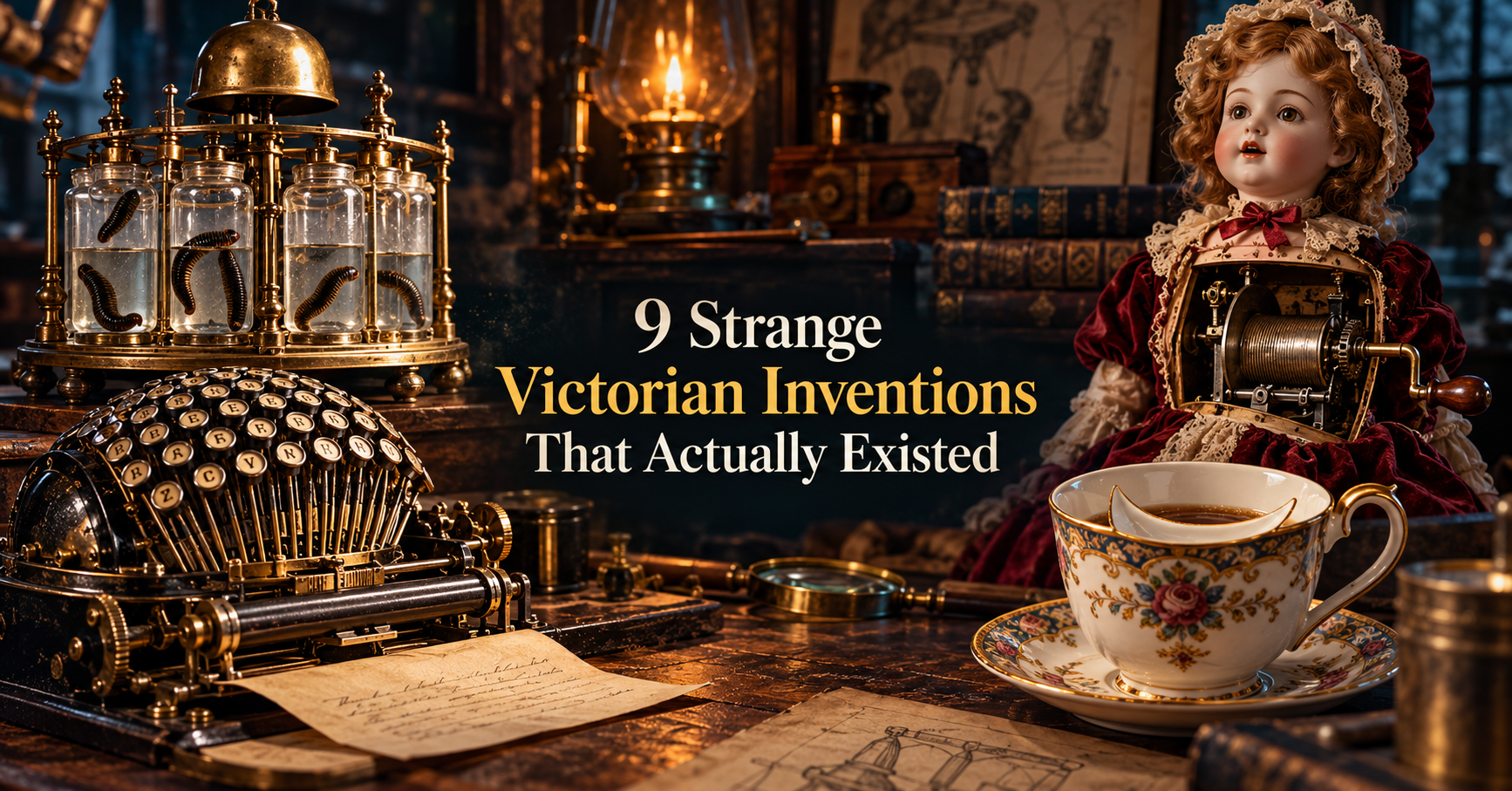
A teacup with a mustache guard sounds like a joke until you picture drinking hot tea through carefully waxed facial hair. A weather alarm operated by leeches takes a little more explaining.
Victorian inventions could be remarkably specific, combining ambitious engineering with everyday worries about comfort, safety, health, and entertainment. The examples below date from Queen Victoria's reign, 1837–1901, and include creations from Britain and elsewhere. All have evidence beyond an imaginative drawing, although being built did not necessarily make an invention successful.
1. A Storm Alarm Powered by Leeches
Whitby doctor George Merryweather built his Tempest Prognosticator in 1850 for display at London's Great Exhibition of 1851. Twelve glass bottles, each containing a live leech, surrounded a central bell.
The idea was to translate the animals' weather-sensitive behavior into a warning. As leeches climbed their bottles, they could disturb a linkage and trigger a hammer. Several signals were supposed to indicate an approaching storm. The device failed to catch on, and the original was lost.
2. An Anti-Garrotting Collar
During London's garrotting scares of the 1860s, personal protection could mean wearing armor around your neck. An example in the Metropolitan Police Historic Collection is a metal collar fitted with barbed hooks.
In a curator interview, Dr. Clare Smith explains that the device was intended to protect against strangulation during street robberies. She also notes that the perceived danger exceeded the actual number of assaults. The collar records both a design response to crime and the intensity of public fear.
3. A Cup That Kept Mustaches Dry
British potter Harvey Adams is credited with inventing the mustache cup in the 1860s. A ledge inside the rim sheltered facial hair while allowing the drinker to sip through an opening.
Thunder Bay Museum preserves an example and explains its practical purpose: keeping a mustache dry and managing the problem of wax softening around hot drinks. The clever part was how little the familiar teacup needed to change. A small ceramic bridge addressed a highly specific grooming inconvenience.
4. A Collapsible Steel Cage for Skirts
The cage crinoline, which emerged in 1856, used steel hoops to support the enormous skirts fashionable at the time. It looks like an improbable piece of wearable architecture.
Yet the Victoria and Albert Museum explains that it offered a lighter alternative to layers of heavy petticoats. Its flexible structure could also collapse for storage. There were serious drawbacks, including difficulties in narrow spaces and fire risks associated with large skirts, but the design was widely adopted.
5. A Camera Shaped Like a Revolver
Thompson's Revolver Camera was patented in 1862 and manufactured by A. Briois in Paris. Its barrel contained a camera lens, and the mechanism recorded four exposures on a circular glass plate.
The V&A describes the practical thinking behind its unusual shape: the photographer could aim and steady it with one hand while using the other to operate the controls. Only a handful were made. The arrangement offers a particularly literal interpretation of taking a shot.
6. A Typewriter With a Ball-Shaped Keyboard
Danish inventor Rasmus Malling-Hansen's writing ball entered manufacture in 1870. Instead of familiar rows of keys, it used a dome of spring-loaded typebars, all angled toward the same printing point.
A surviving example in the Science Museum Group collection has 54 of these bars. Malling-Hansen arranged the characters with typing speed in mind. The result looks unfamiliar because it represents another answer to the keyboard problem, developed while the form of the typewriter was still being established.
7. An Electropathic Belt With Sweeping Promises
In 1880s London, C. B. Harness marketed electropathic belts as wearable sources of curative electricity. Promotional material preserved by the Underpinnings Museum advertised relief for complaints including sleeplessness and muscular rheumatism.
The physical product existed, but its electrical claims attracted skepticism even then. In an 1888 review reproduced by the museum, physician William Langran reported that he could not detect a current from the belt he tested. Its elaborate technological language had outrun the evidence for that device.
8. A Talking Doll With a Phonograph Inside
In 1890, buyers could purchase an Edison talking doll containing a miniature phonograph. Turning a crank on its back rotated a cylinder record, reproducing a voice through a mechanical sound system inside the torso.
The owner could reset playback with a lever, but changing the recording required extensive disassembly. According to the National Park Service, the business venture failed after roughly a month of sales. Recorded entertainment had reached the toy cupboard, with a mechanism that demanded considerable accommodation from its user.
9. A Steam-Powered Lawn Mower
James Sumner of Leyland, Lancashire, designed a steam lawn mower in 1893. An oil-fired boiler supplied its engine, bringing industrial-looking machinery to the task of trimming grass.
The Museum of English Rural Life preserves a machine with a 30-inch cutting width that worked at Elvaston Castle from approximately 1894 to 1929. That service history gives this invention a particularly tangible claim to usefulness. An unusual garden machine could still earn its keep for decades.
Which Ideas Actually Caught On?
Strangeness, usefulness, and commercial success are separate questions. These contrasting outcomes help explain why:
| InventionDocumented outcomeWhat it shows | ||
| Cage crinoline | Widely adopted and mass-produced. | An unfamiliar shape could offer practical advantages. |
| Tempest Prognosticator | Exhibited in 1851 but failed to gain widespread use. | A striking demonstration could remain a curiosity. |
| Edison talking doll | Reached customers, followed by a short-lived business venture. | Manufacturing a product did not guarantee a market. |
| Harness electropathic belt | Advertised and tested; one contemporary reviewer detected no current. | A real object could carry unsupported promises. |
A Museum Replica Is Not the Original Invention
There is another useful distinction when looking at photographs of Victorian gadgets: the date of the idea and the date of the pictured object may differ. Whitby Museum's Tempest Prognosticator was made in 1951 for the Festival of Britain. The museum identifies it as a nonworking reconstruction of the lost Victorian device.
That does not make Merryweather's 1851 exhibit imaginary. It changes what the photograph proves. A surviving original, a later reconstruction, and a patent illustration each preserve different kinds of evidence about an invention's history.
These Victorian inventions reveal an era experimenting with the shape of ordinary life. A ceramic ledge protected a mustache; steel hoops reduced the burden beneath a skirt; a boiler helped maintain an estate's lawn. Other devices struggled to find buyers or deliver on extravagant promises. Looking at their intended jobs makes them more interesting than a collection of strange objects: each captures a moment when someone believed a particular problem deserved a new machine.
Sources
- Whitby Museum — Tempest Prognosticator
- Bow Street Society — Interview With Metropolitan Police Historic Collection Curator Dr. Clare Smith
- Thunder Bay Museum — Moustache Cup
- Victoria and Albert Museum — Corsets, Crinolines and Bustles
- Victoria and Albert Museum — Unusual Cameras of the Royal Photographic Society Collection
- Science Museum Group — Hansen's Writing Ball
- Underpinnings Museum — Harness Electric Corset and Electropathic Belt Promotional Materials
- National Park Service — Edison Talking Doll Recordings, 1888–1890
- National Park Service — Talking Doll Product Operation
- Museum of English Rural Life, University of Reading — Steam Lawnmower, Object 55/338