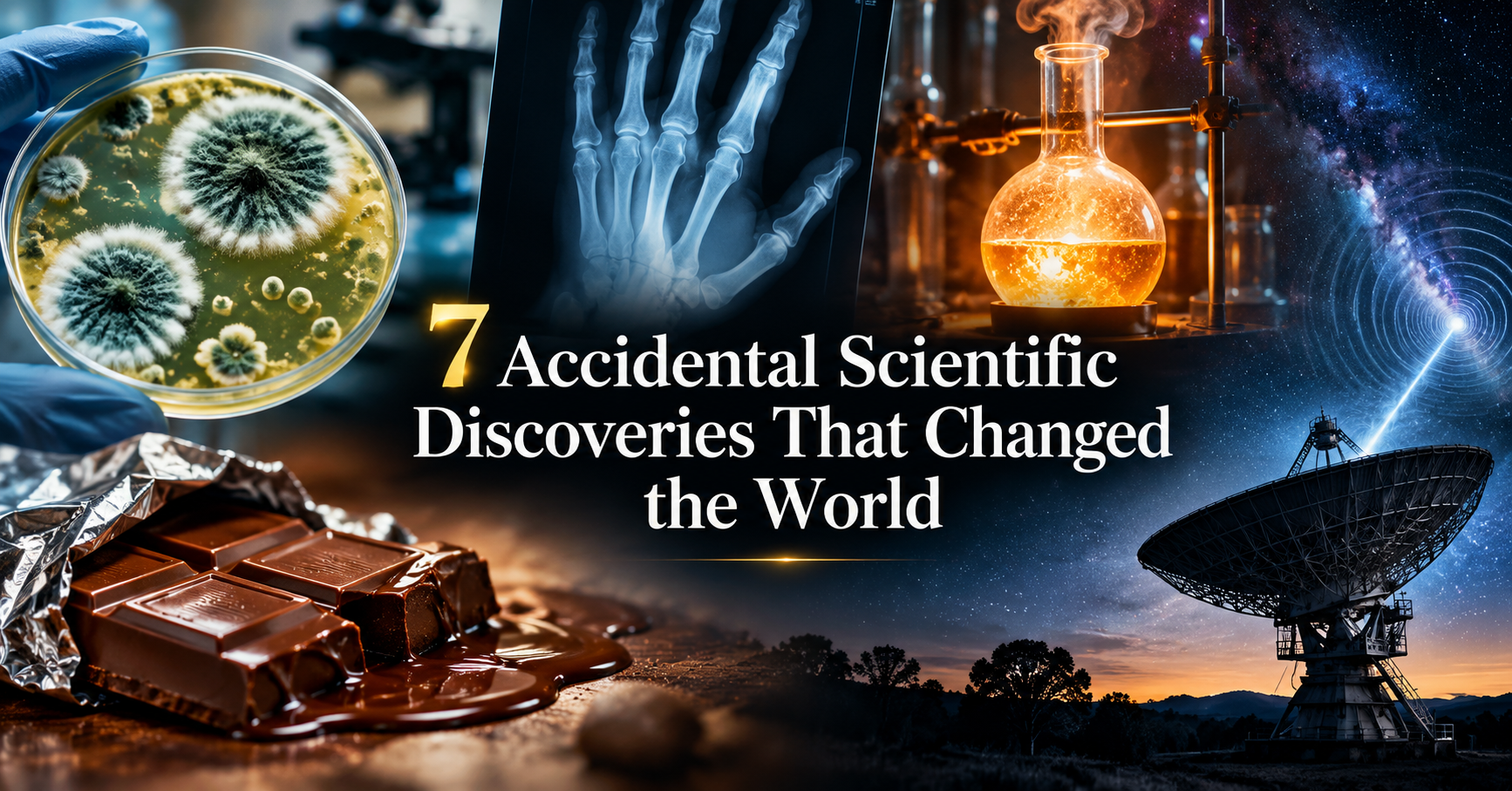
Imagine discovering a life-saving medicine because mold contaminated your experiment. Or finding evidence about the birth of the universe while trying to eliminate annoying noise from a radio antenna.
These stories sound almost too convenient to be true. Yet some of history's most important scientific breakthroughs began with observations that researchers never intended to make.
From antibiotics to microwave ovens, these seven accidental scientific discoveries demonstrate how unexpected results can lead to extraordinary advances. But there is an important twist: chance may create an opportunity, while curiosity, careful experiments, and years of work turn it into something revolutionary.
1. Penicillin: The Mold That Helped Transform Medicine (1928)
In 1928, Scottish bacteriologist Alexander Fleming noticed something unusual in his laboratory at St. Mary's Hospital in London. Mold had contaminated a dish containing Staphylococcus bacteria, but the bacteria near the mold were no longer growing normally.
Instead of discarding the contaminated culture, Fleming investigated. He discovered that the mold produced a substance capable of inhibiting bacterial growth. That substance became known as penicillin.
However, the discovery did not immediately produce a usable medicine. More than a decade later, Howard Florey, Ernst Chain, and their colleagues helped develop penicillin into a practical treatment.
Why it changed the world: Penicillin helped launch the antibiotic era, making many previously dangerous bacterial infections treatable and transforming modern medicine.
2. X-Rays: The Invisible Rays That Revealed Human Bones (1895)
On November 8, 1895, German physicist Wilhelm Conrad Röntgen was experimenting with electrical discharge tubes when he noticed a nearby fluorescent screen glowing unexpectedly.
The tube had been covered with black cardboard. Ordinary visible light could not explain what he was seeing.
Röntgen investigated the mysterious radiation and discovered that it could pass through some materials while being absorbed more strongly by others. One of his most famous early images showed the bones and wedding ring of his wife's hand.
He named the mysterious radiation X-rays because its nature was initially unknown.
Why it changed the world: X-rays made it possible to examine bones and internal structures without surgery. They became essential to medical diagnosis and later influenced security screening and industrial inspection. Their usefulness also required the development of radiation safety practices.
3. Radioactivity: The Experiment Cloudy Weather Couldn't Stop (1896)
French physicist Henri Becquerel wanted to investigate whether uranium salts could produce penetrating radiation after absorbing sunlight.
He prepared photographic plates wrapped in dark paper and placed uranium compounds near them. Unfortunately for his original plan, cloudy weather prevented the sunlight exposure he wanted.
He stored the materials in a drawer. When he developed the plates on March 1, 1896, he found strong images even though the uranium had not been exposed to the expected sunlight.
The crucial realization was that uranium could emit radiation spontaneously.
Why it changed the world: The discovery opened an entirely new field of physics. It inspired major research by Marie and Pierre Curie and eventually contributed to nuclear science, cancer treatments, and nuclear energy, along with the recognition of serious radiation hazards.
4. The Microwave Oven: A Candy Bar That Melted Unexpectedly (1945)
American engineer Percy Spencer was working with magnetrons, devices used to generate microwaves for radar systems, when he noticed that a candy bar in his pocket had melted.
Rather than dismiss the incident, Spencer began experimenting with how microwave energy affected food. He tested other items, including popcorn kernels and an egg.
His observations helped lead to the development of microwave cooking technology. Early commercial microwave ovens were enormous compared with today's kitchen appliances, and decades passed before smaller household models became common.
Why it changed the world: Microwave ovens changed how millions of people heat and prepare food, making reheating and certain cooking tasks dramatically more convenient.
5. Teflon: The Unexpected Powder Inside a Gas Cylinder (1938)
In April 1938, DuPont chemist Roy Plunkett was investigating refrigerant-related chemicals when a cylinder containing tetrafluoroethylene gas behaved strangely.
When its valve was opened, the expected gas did not emerge. Yet the cylinder still had substantial weight.
Plunkett and his colleagues investigated and found a white solid inside. The gas had unexpectedly polymerized into a substance called polytetrafluoroethylene, or PTFE.
PTFE had remarkable properties, including chemical resistance and very low friction. It eventually became associated with the Teflon brand.
Why it changed the world: PTFE found uses in industrial machinery, electrical systems, chemical processing equipment, and nonstick cookware. Its accidental discovery helped introduce an important class of high-performance materials.
6. Cosmic Microwave Background: The Strange Noise Coming From Space (1964)
In 1964, radio astronomers Arno Penzias and Robert Wilson were working with a sensitive antenna at Bell Telephone Laboratories in New Jersey.
They encountered a persistent background signal that seemed to come from every direction in the sky.
They investigated possible sources of interference, including problems with their equipment. But the mysterious signal remained.
What they had detected was the cosmic microwave background: faint radiation left over from the universe's early history.
Why it changed the world: The discovery provided powerful evidence supporting the Big Bang model. Later space missions measured the radiation in extraordinary detail, helping scientists understand the early universe and how cosmic structures developed.
7. Vulcanized Rubber: A Heat Experiment With an Unexpected Result (1839)
In the nineteenth century, natural rubber was difficult to use reliably. It could become sticky in warm conditions and brittle in cold weather.
American inventor Charles Goodyear spent years trying to solve this problem.
According to a famous account, a mixture containing rubber and sulfur accidentally contacted a hot stove in 1839. Instead of simply melting, the material developed useful new properties.
But the familiar accident story needs context. Goodyear had already spent years experimenting with rubber formulations. The breakthrough emerged from sustained work rather than one isolated moment of luck.
Why it changed the world: Vulcanization made rubber more durable, elastic, and useful across a wider range of temperatures. It helped enable modern tires, seals, hoses, and countless other products.
Quick Timeline: Seven Discoveries at a Glance
Although these breakthroughs occurred in different fields, each began with an unexpected observation that challenged an existing assumption.
| Year Discovery Unexpected observation | ||
| 1839 | Vulcanized rubber | Heat altered a rubber mixture in a useful way. |
| 1895 | X-rays | A fluorescent screen glowed near a covered tube. |
| 1896 | Radioactivity | Uranium affected photographic plates without sunlight. |
| 1928 | Penicillin | Mold inhibited bacteria in a culture dish. |
| 1938 | PTFE | A supposedly gas-filled cylinder contained solid material. |
| 1945 | Microwave cooking | Food warmed near radar equipment. |
| 1964 | Cosmic microwave background | An antenna detected unexplained signals from across the sky. |
What Most Stories About Accidental Discoveries Leave Out
The phrase "accidental discovery" can create the misleading impression that scientists simply stumbled into finished inventions.
Myth: Fleming's mold immediately gave the world antibiotics
Fact: Fleming identified penicillin's antibacterial activity in 1928, but developing a medicine required extensive later research, testing, and production work.
Myth: The cosmic microwave background was just ordinary radio interference
Fact: Penzias and Wilson investigated the unwanted signal carefully. Its consistency and characteristics ultimately helped establish its cosmic origin.
Myth: Goodyear invented useful rubber in one lucky second
Fact: The famous stove incident came after years of experimentation. Recognizing and refining the result were essential to developing vulcanized rubber.
Why Unexpected Results Matter in Science
These examples reveal an important principle: a surprising result is not automatically a discovery.
Scientists must recognize the anomaly, investigate its causes, test alternative explanations, and determine whether the effect can be repeated.
Fleming noticed a pattern others might have ignored. Röntgen investigated a glow that did not fit his expectations. Becquerel tested evidence that contradicted his original sunlight hypothesis.
In each case, the scientific method transformed a strange observation into reliable knowledge.
Conclusion: Chance Opens Doors, but Curiosity Changes the World
Some of the most remarkable accidental scientific discoveries began as problems, distractions, or experiments that did not behave as expected.
Yet none of these breakthroughs became transformative through luck alone. Scientists had to ask questions, challenge assumptions, and continue investigating long after the initial surprise.
That is perhaps the most valuable lesson these stories offer: unexpected results are not always failures. Sometimes they reveal something important that no one originally thought to look for.
Sources
- PubMed — Penicillin: Its Discovery and Early Development
- NobelPrize.org — Howard Florey and the Development of Penicillin
- American Physical Society — Röntgen's Discovery of X-Rays
- American Physical Society — Henri Becquerel Discovers Radioactivity
- Smithsonian Institution — Researching Percy Spencer's Biography
- American Physical Society — Discovery of Teflon
- NASA — COBE Science and the Cosmic Microwave Background
- American Chemical Society — Lessons From Charles Goodyear